


How to Build a Cybersecurity-Ready Small Business with Managed IT Services
By MotivIT, LLC Editorial Team · August 26, 2026

Table of Contents
A cyber incident can become a business and financial problem long before leadership understands what happened.
In 2025, the FBI’s Internet Crime Complaint Center received 24,768 Business Email Compromise complaints representing more than $3 billion in reported losses. That figure covers organizations and victims of different sizes, not a typical small-business loss, but it demonstrates how a compromised email account or fraudulent payment request can create serious financial exposure.
For a small business, the damage may begin with one stolen password, missed software update, unprotected device, or former employee account that was never disabled. From there, the incident can interrupt email, expose customer information, delay billing, redirect payments, or force employees to stop using critical systems.
Cybersecurity readiness is therefore not measured by how many security products a company owns. It is measured by whether the business can reduce common risks, detect warning signs, respond effectively, and recover without unnecessary disruption.
This is where managed IT services for small businesses can help. A Managed Service Provider, or MSP, can coordinate user access, endpoint security, Microsoft 365 security, patching, network visibility, employee support, and incident preparation under one accountable service relationship.
MotivIT provides scalable managed IT support for businesses in San Jose and beyond. Its published services include endpoint protection, patch management, Microsoft 365 assistance, network monitoring, cloud services, backup and recovery support, and additional cybersecurity capabilities based on the selected plan.
In 2025, the FBI’s Internet Crime Complaint Center received 24,768 Business Email Compromise complaints representing more than $3 billion in reported losses. That figure covers organizations and victims of different sizes, not a typical small-business loss, but it demonstrates how a compromised email account or fraudulent payment request can create serious financial exposure.
For a small business, the damage may begin with one stolen password, missed software update, unprotected device, or former employee account that was never disabled. From there, the incident can interrupt email, expose customer information, delay billing, redirect payments, or force employees to stop using critical systems.
Cybersecurity readiness is therefore not measured by how many security products a company owns. It is measured by whether the business can reduce common risks, detect warning signs, respond effectively, and recover without unnecessary disruption.
This is where managed IT services for small businesses can help. A Managed Service Provider, or MSP, can coordinate user access, endpoint security, Microsoft 365 security, patching, network visibility, employee support, and incident preparation under one accountable service relationship.
MotivIT provides scalable managed IT support for businesses in San Jose and beyond. Its published services include endpoint protection, patch management, Microsoft 365 assistance, network monitoring, cloud services, backup and recovery support, and additional cybersecurity capabilities based on the selected plan.
Quick Answer
A cybersecurity-ready small business knows which information and systems are critical, protects employee accounts and devices, applies updates consistently, monitors for suspicious activity, gives employees a clear reporting process, and has a documented response plan.
Managed IT services help maintain these protections continuously, giving businesses access to cybersecurity expertise without requiring a complete internal security department.
A cybersecurity-ready small business knows which information and systems are critical, protects employee accounts and devices, applies updates consistently, monitors for suspicious activity, gives employees a clear reporting process, and has a documented response plan.
Managed IT services help maintain these protections continuously, giving businesses access to cybersecurity expertise without requiring a complete internal security department.
Key takeaways:
- Cybersecurity is an ongoing business process, not a one-time software purchase.
- Small businesses should evaluate risks across users, devices, email, cloud platforms, vendors, and sensitive information.
- A cybersecurity risk assessment can reveal gaps that are difficult to see during normal daily operations.
- Managed IT support can provide baseline protection, monitoring, employee assistance, and structured incident escalation.
- More advanced managed security services may be appropriate when a company needs specialized threat monitoring, compliance support, or incident investigation.
- Proactive cybersecurity protects more than data—it also protects productivity, revenue, customer confidence, and operational stability.
Cybersecurity Risk Is Business Risk
Small businesses often manage sensitive customer, financial, employee, or operational information without a dedicated security team.
A company may rely on Microsoft 365, accounting platforms, customer portals, cloud storage, remote access, mobile devices, and outside vendors. Every account and application adds another place where information must be protected and access must be controlled.
Verizon’s 2026 Data Breach Investigations Report found that 31% of breaches began with the exploitation of software vulnerabilities, making vulnerability exploitation the leading breach entry point in that year’s research. The report also found a significant increase in breaches involving third parties.
For an SMB owner, those findings translate into practical questions:
When no one owns these responsibilities, seemingly small gaps can remain unnoticed.
A company may rely on Microsoft 365, accounting platforms, customer portals, cloud storage, remote access, mobile devices, and outside vendors. Every account and application adds another place where information must be protected and access must be controlled.
Verizon’s 2026 Data Breach Investigations Report found that 31% of breaches began with the exploitation of software vulnerabilities, making vulnerability exploitation the leading breach entry point in that year’s research. The report also found a significant increase in breaches involving third parties.
For an SMB owner, those findings translate into practical questions:
- Are important updates being installed?
- Are unsupported applications still in use?
- Do former employees or vendors retain access?
- Is multi-factor authentication applied consistently?
- Who reviews alerts from security tools?
- Can the company restore its most important information?
- Do employees know how to report a suspicious email?
When no one owns these responsibilities, seemingly small gaps can remain unnoticed.
What Happens When a Small Business Gets Hacked?
A cyber incident often develops in stages.
An employee may enter credentials into a fake Microsoft 365 login page. The attacker gains access to email, studies current conversations, and sends a realistic payment request to a client or coworker.
In another scenario, an unpatched application is exploited. The attacker uses that access to move through the network, collect information, or deploy ransomware.
The business impact may include:
The technical incident may begin with one device or account, but its effect can spread across the organization.
An employee may enter credentials into a fake Microsoft 365 login page. The attacker gains access to email, studies current conversations, and sends a realistic payment request to a client or coworker.
In another scenario, an unpatched application is exploited. The attacker uses that access to move through the network, collect information, or deploy ransomware.
The business impact may include:
- Employees losing access to email or files
- Fraudulent payments
- Customer or employee information being exposed
- Systems being disconnected during an investigation
- Legal, insurance, or notification expenses
- Delayed billing and customer service
- Manual reconstruction of lost work
- Damage to customer confidence
The technical incident may begin with one device or account, but its effect can spread across the organization.
Why Security Software Alone Is Not Enough
A small business may already have antivirus software, a firewall, Microsoft 365 security features, or a backup platform.
Those tools still need to be:
A backup application may be installed but quietly failing. MFA may protect email but not an accounting platform or administrator account. Endpoint protection may generate alerts that no one reviews.
Cybersecurity readiness comes from coordinating these controls—not simply purchasing them.
Those tools still need to be:
- Configured correctly
- Updated consistently
- Monitored for failures and alerts
- Reviewed when employees or systems change
- Connected to a clear incident process
- Tested before an emergency
A backup application may be installed but quietly failing. MFA may protect email but not an accounting platform or administrator account. Endpoint protection may generate alerts that no one reviews.
Cybersecurity readiness comes from coordinating these controls—not simply purchasing them.
Assess Your Cybersecurity Readiness
A cybersecurity risk assessment helps leadership understand which systems and information are most important, which threats could affect them, and where current protections may be incomplete.
The NIST Cybersecurity Framework 2.0 Small Business Quick-Start Guide was developed for small and midsize organizations with modest or developing cybersecurity programs. It organizes cybersecurity around six functions: Govern, Identify, Protect, Detect, Respond, and Recover.
The CIS Critical Security Controls Implementation Group 1 provides another practical starting point. CIS describes IG1 as essential cyber hygiene intended for organizations with limited IT and cybersecurity expertise.
For non-technical decision-makers, these frameworks can be simplified into the following readiness checklist:
The NIST Cybersecurity Framework 2.0 Small Business Quick-Start Guide was developed for small and midsize organizations with modest or developing cybersecurity programs. It organizes cybersecurity around six functions: Govern, Identify, Protect, Detect, Respond, and Recover.
The CIS Critical Security Controls Implementation Group 1 provides another practical starting point. CIS describes IG1 as essential cyber hygiene intended for organizations with limited IT and cybersecurity expertise.
For non-technical decision-makers, these frameworks can be simplified into the following readiness checklist:
| Readiness Area | Question for Leadership | Business Risk if the Answer Is Unclear |
|---|---|---|
| Technology inventory | Do we know which devices, accounts, applications, and vendors have access to company information? | Unknown or unprotected systems may remain exposed |
| Identity protection | Is MFA required for email, financial platforms, remote access, and administrator accounts? | Stolen passwords may lead to unauthorized access |
| Employee access | Are permissions reviewed and immediately removed when people leave? | Former users may retain access to sensitive information |
| Endpoint security | Are all company devices protected and monitored? | One compromised device may expose other systems |
| Patching | Who confirms that security updates are installed successfully? | Known vulnerabilities may remain exploitable |
| Email security | Can employees recognize and report phishing or fraudulent payment requests? | Email compromise may lead to data or financial loss |
| Microsoft 365 security | Are user permissions, administrator roles, and suspicious logins reviewed? | Cloud accounts may be misused without detection |
| Security monitoring | Who reviews alerts, and what happens after suspicious activity is detected? | Warning signs may be ignored or investigated too late |
| Vendor access | Which third parties can access systems or data? | A vendor compromise may affect the business |
| Incident response | Who makes decisions during the first hour of a cyber incident? | Confusion may increase damage and recovery time |
| Recovery | Can essential information and systems be restored within an acceptable timeframe? | Operations may remain unavailable longer than expected |
| Compliance | Are required controls and documentation aligned with the company’s industry? | The business may face contractual or regulatory exposure |
Common SMB Security Gaps
A cybersecurity assessment frequently reveals gaps such as:
These weaknesses may not interrupt normal operations immediately. That is why they can remain hidden until an attacker, outage, or employee mistake exposes them.
- Former employee accounts that remain active
- MFA applied to some systems but not others
- Personal or unapproved applications storing business information
- Administrator accounts used for everyday work
- Security alerts with no assigned owner
- Devices that are missing updates
- Incomplete employee onboarding and offboarding
- Vendors with excessive access
- Backups that have not been restored in a test
- No written incident-response process
- No clear record of which information is sensitive
These weaknesses may not interrupt normal operations immediately. That is why they can remain hidden until an attacker, outage, or employee mistake exposes them.
Which cybersecurity gaps could interrupt your business?
Review your accounts, devices, Microsoft 365 environment, vendor access, security controls, and response process before a cyber incident reveals the weaknesses.
Review your accounts, devices, Microsoft 365 environment, vendor access, security controls, and response process before a cyber incident reveals the weaknesses.
How Managed IT Support Improves Cybersecurity Readiness
Managed IT services establish defined ownership for security and technology responsibilities that a small internal team may struggle to maintain consistently.
The exact coverage depends on the provider and service tier. Business owners should confirm which tools, systems, and response services are included.
The exact coverage depends on the provider and service tier. Business owners should confirm which tools, systems, and response services are included.
Protect User Accounts and Microsoft 365
Many cyber incidents begin with compromised credentials, phishing, weak passwords, or excessive permissions.
A managed provider can support Microsoft 365 security and account management through:
CISA recommends strong passwords, MFA, phishing awareness, timely updates, system logging, tested backups, and incident planning as practical protections for small and midsize businesses.
The business benefit is straightforward: fewer unmanaged accounts, more consistent access controls, and a clearer response when an employee reports unusual activity.
A managed provider can support Microsoft 365 security and account management through:
- Multi-factor authentication
- User and administrator access reviews
- Email filtering
- Permission management
- Secure employee onboarding
- Immediate offboarding
- Suspicious-login investigation
- Account recovery assistance
CISA recommends strong passwords, MFA, phishing awareness, timely updates, system logging, tested backups, and incident planning as practical protections for small and midsize businesses.
The business benefit is straightforward: fewer unmanaged accounts, more consistent access controls, and a clearer response when an employee reports unusual activity.
Maintain Endpoint Security and Patching
Every laptop, desktop, server, and mobile device can become an entry point.
A managed approach may include:
MotivIT’s published managed IT services include endpoint protection, patch management, email filtering, threat detection, and additional advanced security capabilities depending on the plan.
This helps reduce the chance that one outdated or poorly configured device will expose a broader part of the business.
A managed approach may include:
- Endpoint protection
- Endpoint detection and response
- Device-health monitoring
- Security configuration standards
- Patch management
- Disk encryption
- Firewall hardening
- Lost-device response
- Software inventory
- Unsupported-system tracking
MotivIT’s published managed IT services include endpoint protection, patch management, email filtering, threat detection, and additional advanced security capabilities depending on the plan.
This helps reduce the chance that one outdated or poorly configured device will expose a broader part of the business.
Monitor Networks and Security Alerts
Technical and security problems do not always create an obvious warning.
A server may stop receiving updates. A firewall may experience unusual traffic. A device may repeatedly disconnect. An account may generate failed login attempts from an unexpected location.
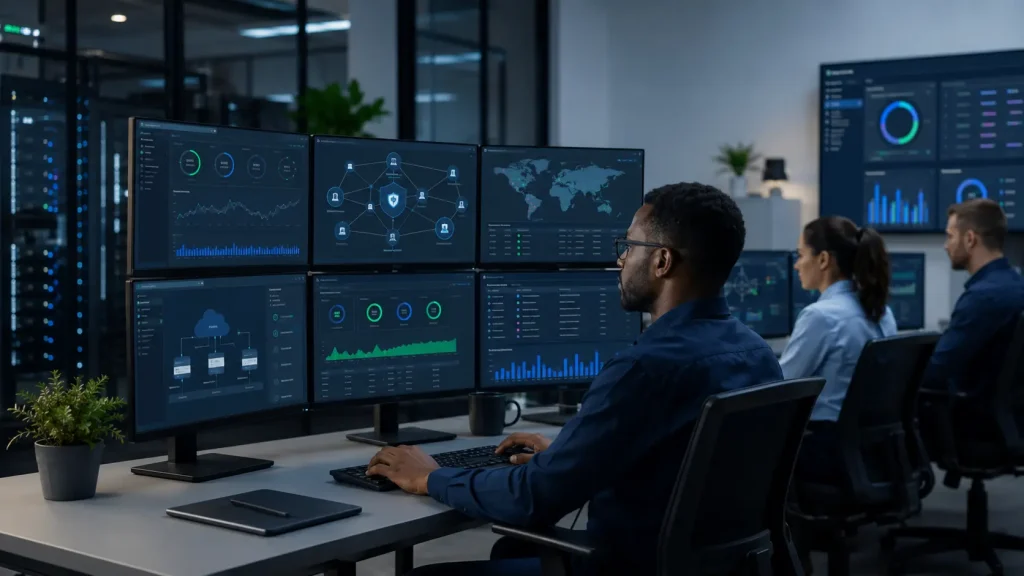
MotivIT’s Network Operations Center provides 24/7 monitoring and management for network infrastructure, including servers, routers, switches, firewalls, and connected devices.
Monitoring cannot guarantee that every attack will be stopped. Its value is visibility: unusual activity can be identified and investigated sooner instead of remaining unnoticed.
Businesses that need deeper threat analysis should ask whether the provider also offers or coordinates managed security services, such as Security Operations Center monitoring, SIEM review, vulnerability management, or specialized incident response.
A server may stop receiving updates. A firewall may experience unusual traffic. A device may repeatedly disconnect. An account may generate failed login attempts from an unexpected location.
MotivIT’s Network Operations Center provides 24/7 monitoring and management for network infrastructure, including servers, routers, switches, firewalls, and connected devices.
Monitoring cannot guarantee that every attack will be stopped. Its value is visibility: unusual activity can be identified and investigated sooner instead of remaining unnoticed.
Businesses that need deeper threat analysis should ask whether the provider also offers or coordinates managed security services, such as Security Operations Center monitoring, SIEM review, vulnerability management, or specialized incident response.
Give Employees a Clear Reporting Channel
Employees are often the first people to notice something unusual.
They may receive a suspicious payment request, see an unexpected login prompt, lose access to an account, or notice that a file has changed.
A structured help desk gives employees one place to report these concerns. MotivIT’s Global Service Desk provides multi-tier technical support, ticket tracking, escalation, and remote issue resolution. Coverage and support hours should be confirmed based on the selected service plan.
Fast reporting can reduce the time between the first warning sign and the technical response.
They may receive a suspicious payment request, see an unexpected login prompt, lose access to an account, or notice that a file has changed.
A structured help desk gives employees one place to report these concerns. MotivIT’s Global Service Desk provides multi-tier technical support, ticket tracking, escalation, and remote issue resolution. Coverage and support hours should be confirmed based on the selected service plan.
Fast reporting can reduce the time between the first warning sign and the technical response.
Prepare for an Incident Before It Happens
Cybersecurity readiness includes a written plan for what the business will do when an account, device, system, or vendor is compromised.
The plan should identify:
CISA advises small businesses to create incident-response plans, involve leadership, conduct tabletop exercises, and define how essential operations will continue during an incident.
The purpose is not to predict every scenario. It is to prevent confusion when time matters.
The plan should identify:
- Who employees contact
- Who can disable accounts
- Who may disconnect systems
- Which vendors must be notified
- Who communicates with customers or employees
- Which systems are restored first
- When legal, insurance, or regulatory support is required
- How decisions and evidence will be documented
CISA advises small businesses to create incident-response plans, involve leadership, conduct tabletop exercises, and define how essential operations will continue during an incident.
The purpose is not to predict every scenario. It is to prevent confusion when time matters.
Maintain a Realistic Recovery Path
Recovery should be discussed in cybersecurity terms, not as a general IT feature.
Ransomware, compromised accounts, destructive malware, and malicious insiders may affect business information. Recovery copies must therefore be monitored, protected, and tested.
MotivIT’s cloud and disaster recovery services include backup, data redundancy, cloud security, monitoring, and disaster recovery capabilities.
A cybersecurity-ready business should know:
The business outcome is not simply “having backups.” It is knowing whether essential operations can be restored after a cyber incident.
Ransomware, compromised accounts, destructive malware, and malicious insiders may affect business information. Recovery copies must therefore be monitored, protected, and tested.
MotivIT’s cloud and disaster recovery services include backup, data redundancy, cloud security, monitoring, and disaster recovery capabilities.
A cybersecurity-ready business should know:
- Which critical information is protected
- Whether backup failures are reviewed
- Whether recovery copies are isolated appropriately
- Who authorizes a restoration
- How recently restoration was tested
- Which systems must return first
The business outcome is not simply “having backups.” It is knowing whether essential operations can be restored after a cyber incident.
Managed IT Support vs. Managed Security Services
Managed IT support and managed security services address related but different needs.
| Area | Managed IT Support | Managed Security Services |
|---|---|---|
| Primary role | Maintain daily technology operations and baseline security | Provide deeper threat detection, analysis, and response |
| Employee help desk | Commonly included | Usually limited or not included |
| Microsoft 365 administration | Often included | Focuses primarily on security configuration and threat activity |
| Endpoint protection | May deploy and manage baseline protection | May add advanced detection and threat hunting |
| Patching | Commonly included | May evaluate vulnerability exposure and remediation priorities |
| Network monitoring | Focuses on availability, performance, and infrastructure alerts | Focuses on security events and suspicious behavior |
| Security assessments | May be included in business reviews | Often provides deeper risk, vulnerability, or compliance assessments |
| Incident response | May escalate and provide initial support | May investigate, contain, and coordinate specialized response |
| Compliance | Supports technical safeguards and documentation | May provide specialized compliance assessments and monitoring |
| Best fit | SMBs needing reliable IT operations plus foundational security | Businesses with higher risk, regulatory obligations, or advanced monitoring needs |
Many SMBs benefit from managed IT support as their foundation. More advanced SMB cybersecurity services can then be added as the business’s risk, data sensitivity, contractual requirements, or regulatory responsibilities increase.
The provider should clearly explain where managed IT ends and specialized managed security services begin.
The provider should clearly explain where managed IT ends and specialized managed security services begin.
Cybersecurity Priorities for Data-Sensitive Industries
The right cybersecurity strategy depends on the information the company handles and the operational effect of losing access to it.
Financial Services, Lending, and Accounting
These businesses may manage financial statements, tax records, payroll information, borrower documents, bank details, loan-origination systems, and payment instructions.
Their priorities may include:
Business Email Compromise is particularly relevant because attackers frequently impersonate executives, vendors, or trusted contacts to redirect payments. The FBI’s 2025 IC3 report recorded more than $3 billion in reported Business Email Compromise losses.
Their priorities may include:
- Email and impersonation protection
- MFA for financial and administrative accounts
- Secure document sharing
- Access reviews
- Vendor-risk management
- Logging and monitoring
- Endpoint security
- Incident escalation
- Recovery testing
Business Email Compromise is particularly relevant because attackers frequently impersonate executives, vendors, or trusted contacts to redirect payments. The FBI’s 2025 IC3 report recorded more than $3 billion in reported Business Email Compromise losses.
Healthcare, Insurance, and Legal Services
These organizations often handle confidential client, patient, policyholder, or case-related information.
Their readiness priorities may include:
Cybersecurity compliance for small businesses should not be treated as a product that an MSP can guarantee. A provider may help implement controls, documentation, monitoring, and reporting, but the business remains responsible for its policies, employees, vendors, and legal obligations.
Their readiness priorities may include:
- Strong user access controls
- Device encryption
- Secure communications
- Employee-awareness training
- Vendor-access management
- Backup testing
- Incident documentation
- Compliance-aligned technical safeguards
Cybersecurity compliance for small businesses should not be treated as a product that an MSP can guarantee. A provider may help implement controls, documentation, monitoring, and reporting, but the business remains responsible for its policies, employees, vendors, and legal obligations.
Manufacturing and Multi-Location Businesses
Manufacturers and distributed organizations may rely on office systems, production applications, local servers, network equipment, inventory platforms, and outside vendors.
Their cybersecurity plan should address:
A compromise affecting one workstation should not be able to spread freely across the broader operation.
Their cybersecurity plan should address:
- Office and operational devices
- Network segmentation
- Vendor access
- Patch planning
- Remote connectivity
- Device monitoring
- Account management
- Incident containment
A compromise affecting one workstation should not be able to spread freely across the broader operation.
How to Choose a Cybersecurity-Focused MSP
Not every managed provider includes the same security tools, monitoring coverage, or response services.
Before signing an agreement, ask:
Before signing an agreement, ask:
| Area | Buyer-Focused Question |
|---|---|
| Cybersecurity risk assessment | How will you identify and prioritize our current security gaps? |
| Asset visibility | Will you maintain an inventory of users, devices, applications, and vendors? |
| Endpoint security | Which devices, protections, and operating systems are included? |
| Microsoft 365 security | Will you manage MFA, administrator access, permissions, onboarding, and offboarding? |
| Patch management | Which operating systems and applications are covered? |
| Email protection | Are phishing protection, spam filtering, and encryption included? |
| Security monitoring | Which alerts are reviewed, and during what hours? |
| Incident response | Will you only notify us, or help investigate and contain the problem? |
| Recovery | Who monitors recovery systems, and how often is restoration tested? |
| Employee reporting | How do users report suspicious activity? |
| Compliance support | Can you support our industry without promising automatic compliance? |
| Reporting | What will leadership receive about risks, alerts, and improvements? |
| Managed security services | Can you provide or coordinate SOC monitoring, SIEM, assessments, or advanced response? |
| Scalability | Can the security program expand as the company grows? |
| Additional costs | Which tools, projects, and response services are billed separately? |
MotivIT’s managed IT services for San Jose businesses combine user support, endpoint protection, patch management, network monitoring, Microsoft 365 assistance, cloud services, backup and recovery support, and scalable cybersecurity options. MotivIT also describes its security protocols as SOC 2 Type 2 certified.
A provider should be able to explain each service in business terms: what risk it addresses, who owns the responsibility, how an alert is handled, and what happens during a real incident.
A provider should be able to explain each service in business terms: what risk it addresses, who owns the responsibility, how an alert is handled, and what happens during a real incident.
Do you know which cybersecurity gaps present the greatest risk to your business?
Review your users, devices, Microsoft 365 environment, vendor access, monitoring, and incident procedures with MotivIT.
Review your users, devices, Microsoft 365 environment, vendor access, monitoring, and incident procedures with MotivIT.
Frequently Asked Questions About Small Business Cybersecurity
Do small businesses need managed cybersecurity?
A business may need managed cybersecurity when it relies on cloud platforms, remote users, sensitive information, or regulated systems but lacks internal resources to maintain security controls consistently.
What is a cybersecurity risk assessment?
A cybersecurity risk assessment identifies important systems and information, evaluates likely threats and vulnerabilities, reviews current protections, and prioritizes practical improvements based on business risk.
How can an MSP protect a small business from cyber threats?
An MSP can coordinate identity protection, endpoint security, patching, Microsoft 365 administration, monitoring, employee support, vendor access, incident escalation, and recovery preparation.
What is the difference between managed IT support and managed security services?
Managed IT support covers daily technology operations and foundational security. Managed security services focus more deeply on threat monitoring, analysis, incident response, compliance, and advanced risk reduction.
Does every business need 24/7 security monitoring?
Not necessarily. The appropriate coverage depends on operating hours, data sensitivity, regulatory responsibilities, customer commitments, and the systems the business cannot afford to lose.
What should endpoint security include?
Endpoint security may include antivirus, endpoint detection and response, device monitoring, patching, encryption, firewall configuration, application controls, and lost-device procedures.
How does an MSP improve Microsoft 365 security?
An MSP may manage MFA, user permissions, administrator accounts, email protection, suspicious-login response, secure onboarding, offboarding, and account recovery.
Can managed IT services guarantee regulatory compliance?
No. An MSP can help implement technical safeguards, documentation, monitoring, and reporting, but compliance also depends on the business’s policies, people, vendors, contracts, and legal obligations.
What happens when a small business gets hacked?
The business may need to disable accounts, disconnect systems, investigate the incident, restore information, communicate with affected parties, contact insurance or legal advisers, and document its response. A prepared company will have these responsibilities assigned before an incident occurs.
How much do SMB cybersecurity services cost?
Pricing depends on users, devices, Microsoft 365 accounts, monitoring hours, endpoint tools, compliance needs, incident-response coverage, and the complexity of the environment. Businesses should compare responsibilities and included protections rather than choosing based only on the lowest fee.
Does MotivIT provide small business cybersecurity services?
MotivIT provides managed and co-managed IT services that can include endpoint protection, patch management, Microsoft 365 assistance, network monitoring, user support, cloud services, backup and recovery support, and additional cybersecurity options depending on the plan.
Build Cybersecurity Readiness Before an Incident Tests It
Cybersecurity readiness is not measured by the number of tools listed on an invoice.
It is measured by whether the company knows what it must protect, maintains its security controls, responds when employees report something suspicious, and can continue operating when an incident occurs.
For an SMB without dedicated security resources, managed IT services can provide the structure needed to turn disconnected tools into an ongoing cybersecurity process.
MotivIT helps businesses establish clearer ownership across user access, endpoint security, Microsoft 365, patching, monitoring, employee support, and incident preparation.
Proactive cybersecurity protects more than company data. It protects revenue, productivity, customer confidence, and the organization’s ability to serve customers when its technology is under pressure.
The best time to find a security gap is before an attacker, employee mistake, or system failure exposes it.
Contact MotivIT to review your current security controls, identify the risks most likely to affect your operations, and build a managed IT strategy around your business priorities.
It is measured by whether the company knows what it must protect, maintains its security controls, responds when employees report something suspicious, and can continue operating when an incident occurs.
For an SMB without dedicated security resources, managed IT services can provide the structure needed to turn disconnected tools into an ongoing cybersecurity process.
MotivIT helps businesses establish clearer ownership across user access, endpoint security, Microsoft 365, patching, monitoring, employee support, and incident preparation.
Proactive cybersecurity protects more than company data. It protects revenue, productivity, customer confidence, and the organization’s ability to serve customers when its technology is under pressure.
The best time to find a security gap is before an attacker, employee mistake, or system failure exposes it.
Contact MotivIT to review your current security controls, identify the risks most likely to affect your operations, and build a managed IT strategy around your business priorities.
Turn Cybersecurity Readiness Into Business Resilience
Protect your employees, customer information, revenue, and critical operations with a security strategy built around continuous monitoring, stronger controls, and tested recovery.