


Managed IT Services for Cybersecurity: How SMBs Can Reduce Risk
By MotivIT, LLC Editorial Team · Published August 12, 2026
Table of Contents
A single compromised account can interrupt email, expose confidential files, redirect a payment, or give an attacker access to other business systems.
For small and midsize businesses, the challenge is rarely a complete lack of security software. The larger problem is making sure accounts are protected, updates are applied, backups are monitored, alerts are reviewed, and employees know how to report suspicious activity.
That requires ongoing management.
Managed IT services connect cybersecurity with daily technology operations. Instead of treating security as a one-time project, a Managed Service Provider, or MSP, helps maintain systems, monitor risks, support employees, and prepare the business to recover.
MotivIT provides managed IT services that combine employee support, network monitoring, cybersecurity controls, Microsoft 365 assistance, backup oversight, and technology planning. Depending on the selected plan, its services may include endpoint protection, patch management, email filtering, multi-factor authentication, and 24/7/365 remote monitoring.
Do small businesses need managed cybersecurity?
Many do—especially when they rely on Microsoft 365, cloud applications, remote employees, customer information, or regulated data but do not have a dedicated internal security team.
How can an MSP protect my business from cyber threats?
An MSP can coordinate patching, identity protection, endpoint security, monitoring, backups, employee support, and incident response so that security controls are maintained rather than installed and forgotten.
Managed IT Services vs. Cybersecurity Services
Managed IT services and cybersecurity services overlap, but they are not identical.
Managed IT services oversee the broader technology environment, including devices, users, networks, Microsoft 365, cloud platforms, help desk support, backups, and vendor management.
Cybersecurity services focus more specifically on protecting systems and information from threats. These may include risk assessments, vulnerability testing, security monitoring, incident response, compliance support, and advanced threat protection.
| Area | Managed IT Services | Specialized Cybersecurity Services |
|---|---|---|
| Main purpose | Manage and support daily business technology | Identify, reduce, and respond to security risk |
| Employee support | Usually included | Usually limited |
| Network and device management | Commonly included | Focused on security-related activity |
| Patching | May be managed continuously | May assess whether patching is effective |
| Microsoft 365 | User, permission, email, and license support may be included | Focuses on identity, access, email, and security configuration |
| Monitoring | May cover availability, performance, backups, and alerts | May include SIEM, SOC monitoring, threat detection, or security-event analysis |
| Backups | Monitoring and recovery planning may be included | May evaluate resilience against ransomware and data loss |
| Assessments | Usually part of recurring reviews | Often includes deeper testing or compliance assessments |
| Incident response | Escalation may be included | Specialized investigation and containment may be available |
| Best use | Continuous IT operations and baseline security | Advanced testing, compliance, monitoring, or incident expertise |
For many SMBs, the strongest model is not choosing one or the other. It is using managed IT services for continuous coverage and adding specialized IT security services when the organization needs deeper testing, regulatory guidance, or advanced monitoring.
Why Small Businesses Need Managed Cybersecurity
Small businesses face many of the same threats as larger organizations but often have fewer internal specialists available to manage them.
The Verizon 2026 Data Breach Investigations Report and Breach Impact Study analyzed more than 22,000 breaches across 145 countries and approximately 70,000 cyber-insurance claims. The research shows that the financial effects of an incident can extend beyond direct payments to include response, recovery, restoration, and business interruption.
These findings do not mean every SMB will experience the same level of loss. They demonstrate why cybersecurity must be treated as an operational responsibility rather than an occasional technical task.
Security Tools Still Need Management
Many companies already have antivirus software, a firewall, cloud email protection, or backup software.
Those tools still need to be:
- Configured correctly
- Updated consistently
- Monitored for alerts
- Reviewed after changes
- Connected to a response process
- Tested before an emergency
A business may have endpoint protection but no one reviewing its alerts. It may use Microsoft 365 but apply multi-factor authentication inconsistently. It may have backup software installed but no process for confirming whether restoration works.
Managed IT services help coordinate those controls around the way the business actually operates.
Cybersecurity Affects Daily Operations
A cyber incident can prevent employees from accessing email, delay billing, interrupt customer service, disable shared files, or require systems to be disconnected during an investigation.
For company leaders, cybersecurity is directly connected to:
- Productivity
- Business continuity
- Customer trust
- Financial risk
- Regulatory responsibilities
- Data availability
- Disaster recovery
The goal is not only to block attacks. It is to reduce disruption and improve the company’s ability to respond and recover.
Unsure whether your current protections are being monitored consistently? Review your accounts, devices, backups, and response procedures before a security incident exposes the gaps.
How an MSP Protects a Small Business
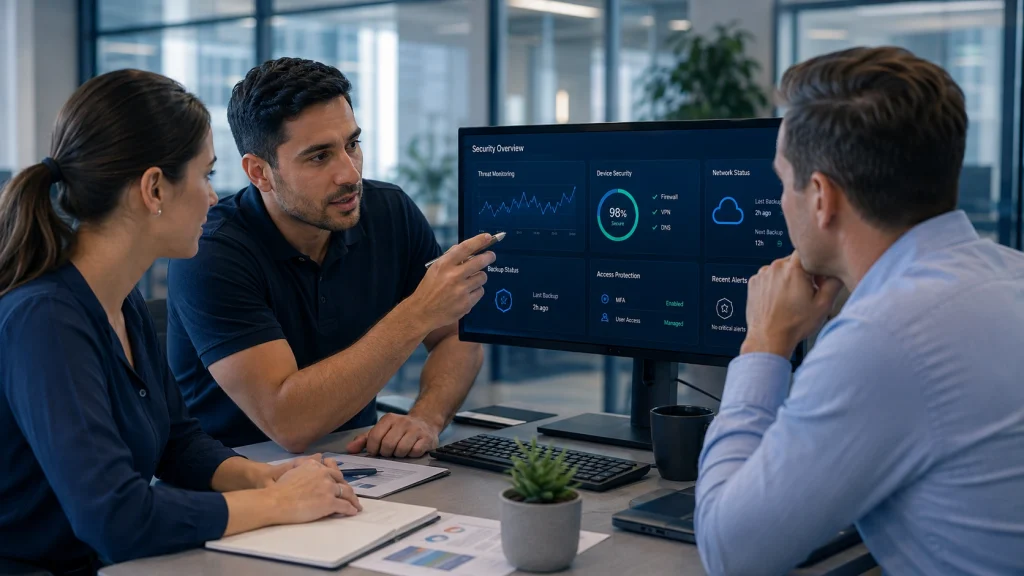
An MSP reduces cyber risk by applying security controls across the users, devices, networks, and cloud platforms that support daily work.
The exact coverage depends on the service agreement. A strong plan should address prevention, visibility, employee support, and recovery.
Identity, Email, and Microsoft 365 Protection
Many attacks target users rather than physical infrastructure.
Phishing messages, stolen passwords, fake login pages, and fraudulent payment requests can expose email, cloud files, financial platforms, and customer records.
An MSP may support identity and email security through:
- Multi-factor authentication
- Email filtering and phishing protection
- User-access reviews
- Permission management
- Account monitoring
- Secure onboarding
- Rapid offboarding
- Microsoft 365 administration
These controls become more important as the company adds employees, contractors, cloud applications, and shared systems.
Patch and Vulnerability Management
Operating systems, browsers, business applications, firewalls, and cloud tools regularly receive updates that correct known weaknesses.
Managed patching creates a repeatable process for identifying missing updates, prioritizing critical fixes, reviewing failed installations, and tracking unsupported systems.
The 2026 Verizon DBIR reported that vulnerability exploitation had surpassed stolen credentials as the leading breach entry point, reinforcing the importance of timely patching and vulnerability management.
Endpoint and Device Security
Every company laptop, desktop, server, and mobile device can become an entry point.
An MSP may help:
- Deploy endpoint protection
- Monitor device health
- Apply security configurations
- Track company equipment
- Remove access from lost devices
- Standardize onboarding and offboarding
- Identify unsupported systems
This provides greater consistency for businesses with remote employees, hybrid teams, or multiple locations.
Network and Security Monitoring
Security problems do not always begin with an obvious warning.
A device may communicate with an unusual destination. A user account may experience repeated login attempts. A server may stop receiving updates. A backup may begin failing silently.
Monitoring helps technical teams identify warning signs earlier.
MotivIT’s Network Operations Center is positioned around continuous network monitoring and management, while its managed plans include 24/7/365 remote monitoring and management. Its Global Service Desk provides around-the-clock support for user and business technology issues.
Businesses evaluating a provider should ask whether monitoring includes only system availability or also security-event review, SIEM tools, or Security Operations Center coverage.
Backups and Ransomware Recovery
Cybersecurity protection must include recovery.
Even strong preventive controls cannot eliminate every ransomware incident, hardware failure, accidental deletion, or cloud outage. Businesses need to know whether critical information can be restored and how quickly essential operations can resume.
A managed backup strategy may include:
- Scheduled backups
- Success and failure monitoring
- Off-site or cloud storage
- Recovery testing
- Retention policies
- Recovery time objectives
- Recovery point objectives
- Documented restoration procedures
Verizon’s 2026 Breach Impact Study found that business interruption accounted for a disproportionate share of overall claim costs when it occurred. The same research found that many ransomware-related losses also involved restoration, response, or recovery rather than ransom payments alone.
MotivIT’s cloud services can support organizations evaluating cloud infrastructure, backups, remote access, and disaster recovery.
Having backup software is not the same as having a tested recovery plan. Confirm what is protected, who monitors failures, and how quickly your critical systems can be restored.
Help Desk and Incident Escalation
Employees are often the first people to notice suspicious activity.
They may receive an unusual email, lose access to an account, see an unexpected prompt, or notice that a file has changed. They need a clear way to report the problem.
A structured Global Service Desk helps employees report issues while allowing the technical team to document, prioritize, escalate, and resolve incidents.
Fast reporting does not replace security tools, but it can reduce the time an attacker or compromised account remains undetected.
Cybersecurity Gaps SMBs Commonly Miss
Security risk often increases gradually as a business adds employees, devices, cloud platforms, and vendors.
The most common gaps are not always highly technical. They frequently result from unclear ownership and inconsistent processes.
Former Users Retain Access
Former employees, contractors, or vendors may retain access longer than necessary.
A documented offboarding process should remove access to email, cloud storage, remote connections, financial platforms, and shared credentials.
MFA Is Applied Inconsistently
A company may protect email with MFA but leave accounting software, remote access, or administrative accounts dependent on passwords alone.
High-risk and privileged accounts should receive priority.
Backups Are Not Reviewed
Backup jobs can fail because of expired credentials, storage limits, network problems, or configuration errors.
Without monitoring, the business may discover the failure only when recovery is required.
Unapproved Applications Store Business Data
Employees may use personal storage accounts or unapproved collaboration tools because they are convenient.
These applications can create weak access controls, incomplete records, and data-exposure risks.
Vendor Access Is Not Controlled
Software vendors, payment processors, consultants, and other providers may have access to business systems or sensitive information.
Companies should understand what each vendor can access, how that access is secured, and how it will be removed when no longer needed.
No Documented Incident Plan Exists
During an incident, employees may not know whom to contact, which systems should be disconnected, how customers should be informed, or which operations must be restored first.
Written escalation, communication, and recovery procedures reduce uncertainty.
Security gaps often develop between tools, users, and vendors—not because a business has no protection at all.
Using NIST, CIS Controls, and Security Monitoring
SMBs do not need to invent a cybersecurity program from scratch.
Recognized frameworks can help companies organize priorities and evaluate whether their protections are complete.
NIST Cybersecurity Framework 2.0
The NIST Cybersecurity Framework 2.0 Small Business Quick-Start Guide was developed for SMBs with modest or no existing cybersecurity plan. It gives businesses a structured way to manage risk through the Govern, Identify, Protect, Detect, Respond, and Recover functions.
An MSP can use this structure to help leadership connect security activities to business priorities rather than viewing cybersecurity as a collection of unrelated tools.
CIS Critical Security Controls
The CIS Controls v8.1 provide 18 prioritized controls covering areas such as asset inventory, data protection, secure configuration, account management, vulnerability management, logging, backups, incident response, and security awareness. CIS describes them as a prescriptive and simplified set of cybersecurity best practices.
CIS Implementation Group 1 is designed as a practical starting point for smaller organizations using common commercial hardware and software.
SOC and Security Monitoring
A Security Operations Center, or SOC, focuses on reviewing security events, detecting suspicious activity, and coordinating responses.
Not every SMB needs a fully dedicated internal SOC. However, businesses with sensitive data, regulatory obligations, extended operating hours, or high-risk systems may benefit from managed security monitoring.
When evaluating SOC-related coverage, ask:
- Which logs and systems are monitored?
- Is the service available 24/7?
- Who reviews alerts?
- What tools are used?
- How are incidents escalated?
- Is containment included?
- What reporting will leadership receive?
MotivIT’s Security and Compliance Proof Points
MotivIT reports that it is SOC 2 Type II certified and HIPAA compliant. It also highlights more than 20 years of experience, 24/7 monitoring, a global service desk, and a Network Operations Center.
Its published managed IT plans include measurable security components such as:
- Endpoint protection
- Patch management
- 24/7/365 remote monitoring and management
- Email spam filtering
- Microsoft 365 multi-factor authentication
- Backup and recovery support
- Advanced security services at higher plan levels
The specific controls available depend on the selected plan, so businesses should confirm scope during the assessment process.
Cybersecurity for Regulated Industries
Regulated and data-sensitive businesses often need tighter access controls, stronger documentation, reliable backups, and clearer incident-response procedures.
Financial Services
Financial services firms manage confidential client records, payment information, account documents, and regulated communications.
Their priorities may include:
- MFA and privileged-access controls
- Email and impersonation protection
- Endpoint security
- Logging and monitoring
- Secure remote access
- Backup testing
- Vendor-risk management
- Incident documentation
A compromised email account can create both data exposure and fraudulent payment risk.
Lending Companies
Lenders may depend on loan-origination platforms, credit information, customer portals, document-management systems, and third-party verification services.
An MSP can help coordinate device protection, user permissions, vendor access, backups, and business continuity so that one technical problem does not delay loan processing or expose borrower information.
Insurance Firms
Insurance companies handle policyholder information, claims documents, financial records, and communications with external agents and service providers.
Their security strategy may need to address:
- Identity and access management
- Secure document sharing
- Email protection
- Third-party access
- Mobile-device security
- Backup retention
- Incident-response procedures
Accounting Firms
Accounting practices manage tax records, payroll data, financial documents, and sensitive client communications.
Risk can increase during tax season when workloads rise and attackers know firms are processing urgent payments and confidential files.
Managed cybersecurity can help maintain Microsoft 365 security, backups, employee support, MFA, access reviews, and email filtering during peak periods.
Healthcare and Legal Services
Healthcare practices and law firms also manage sensitive records and strict confidentiality requirements.
They commonly need reliable backups, access controls, endpoint protection, secure communications, employee training, and compliance-aware procedures.
MotivIT states that its SOC 2 Type II certification, HIPAA alignment, global service desk, and 24/7 monitoring support businesses with security and compliance requirements.
Choosing a Cybersecurity-Focused MSP
Not every provider includes the same security capabilities.
Before signing an agreement, ask for a clear explanation of what is included and which services require an additional subscription or specialist.
| Area | Buyer-Focused Questions |
|---|---|
| Monitoring | Which systems and security events are monitored, and during what hours? |
| Endpoint protection | Which devices are covered, and who responds to alerts? |
| Patch management | Which operating systems and applications are included? |
| Identity security | Does the plan include MFA, access reviews, and account management? |
| Email security | Are phishing protection and spam filtering included? |
| Backups | Who monitors backup failures, and how often is restoration tested? |
| Incident response | Does the provider only notify us, or will it help contain the issue? |
| Microsoft 365 | Are permissions, email security, onboarding, and offboarding managed? |
| SOC services | Is security-event monitoring included, optional, or delivered through a partner? |
| Framework alignment | Can the provider map recommendations to NIST CSF or CIS Controls? |
| Compliance | Does the provider understand our industry and data obligations? |
| Reporting | What security reports and recommendations will leadership receive? |
| Cyber insurance | Can the provider help document controls requested by an insurer? |
| Business continuity | Will the provider help define recovery priorities and procedures? |
MotivIT’s managed IT services in San Jose combine technical support, monitoring, cybersecurity, Microsoft 365 assistance, backups, and scalable service options. Its service model can operate as a complete external IT team or supplement existing internal employees.
Frequently Asked Questions
Do small businesses need managed cybersecurity?
A business may need managed cybersecurity when it relies on cloud platforms, remote users, sensitive information, or regulated systems but lacks the internal staff to maintain security controls consistently.
How can an MSP protect my business from cyber threats?
An MSP can coordinate patching, endpoint protection, MFA, email security, access management, backup monitoring, employee support, and incident escalation across the company’s environment.
What is the difference between managed IT and managed cybersecurity?
Managed IT covers the broader technology environment, including support, networks, devices, cloud tools, and backups. Managed cybersecurity focuses more deeply on threat detection, security monitoring, compliance, incident response, and risk reduction.
Does every managed IT plan include cybersecurity?
No. Coverage varies by provider and service tier. Confirm which tools, devices, monitoring hours, response services, and security controls are included.
Should an MSP follow NIST or CIS Controls?
Using recognized frameworks can make recommendations easier to organize and evaluate. NIST CSF 2.0 provides a risk-management structure, while CIS Controls provide prioritized technical and operational safeguards.
Does my small business need SOC monitoring?
It depends on operating hours, data sensitivity, regulatory obligations, and risk exposure. Companies that require continuous threat review may benefit from SOC or managed security monitoring.
Can an MSP guarantee that we will never be breached?
No. No provider can eliminate every cyber risk. The goal is to reduce exposure, identify warning signs earlier, respond effectively, and recover more quickly.
How do backups protect against ransomware?
Backups give the company a recovery option when files are encrypted, deleted, or unavailable. They must be isolated where appropriate, monitored, and tested to confirm restoration works.
What should financial and lending companies ask an MSP?
They should ask about access controls, email protection, logging, vendor management, incident response, backup testing, security reporting, and experience with regulated data.
How much do managed cybersecurity services cost?
Pricing depends on users, devices, support hours, monitoring scope, security tools, compliance needs, backups, and incident-response coverage. Compare included protections rather than selecting solely on price.
Does MotivIT offer cybersecurity-focused managed IT services?
Yes. MotivIT offers managed IT plans with monitoring, endpoint protection, patching, Microsoft 365 support, backups, help desk services, and additional cybersecurity capabilities depending on the selected plan.
Build a More Practical Cybersecurity Strategy
Small business cybersecurity does not improve through one product alone.
It requires coordinated protection across employees, devices, email, networks, cloud applications, backups, vendors, and recovery processes. It also requires someone to maintain those controls and respond when something changes.
Managed IT services can give SMBs that structure without requiring them to build every capability internally.
MotivIT helps businesses improve visibility, reduce security gaps, support employees, and strengthen recovery planning through scalable managed IT services.
Contact MotivIT to review your current protections, identify practical security gaps, and build a managed IT strategy around your users, data, systems, and business risks.
How Ready Is Your Business for the Next Cyber Threat?
Review your security controls, monitoring, backups, and response plan with MotivIT—and identify the gaps that could put your operations and data at risk.